Materials
Cork Roller vs. Foam Roller: What the Material Actually Changes
A direct comparison of cork and foam as recovery surfaces — density, durability, hygiene, and how each one feels under sustained use.
Sōmavel Editorial10 min read
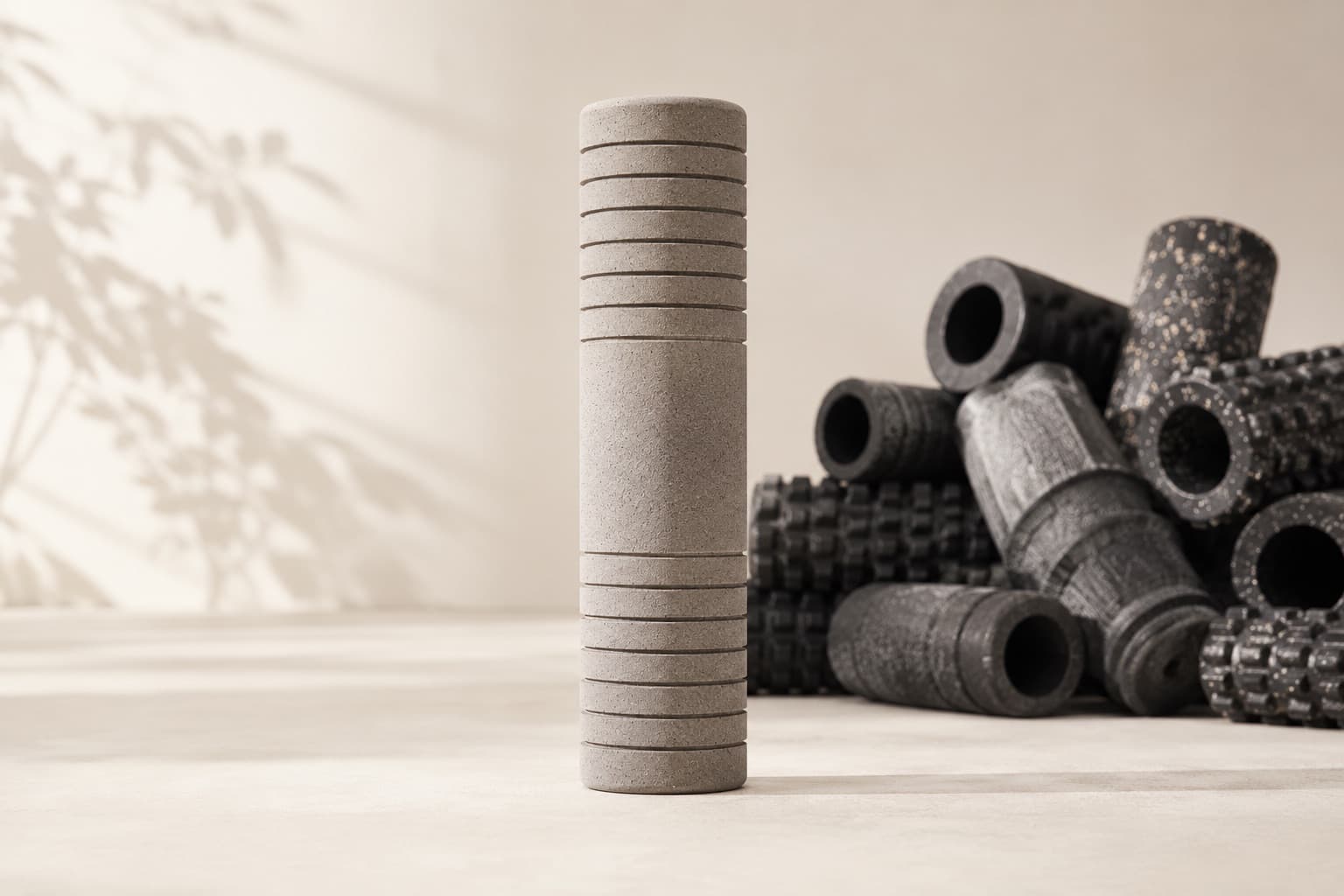
If you've used a foam roller for any length of time, you already know the arc. It works well for a few months, then it doesn't. The surface goes flat where you lean heaviest. The pressure stops reaching the tissue that needs it. You buy another one. The cycle is so normalized that most people don't question it — they assume rollers are disposable by nature. They aren't. The material just is.
Cork changes that dynamic. Not because it's novel or exotic, but because the material behaves differently under load, over time, and against skin. This is a direct comparison — what each material actually does, where it holds up, and where it doesn't.
What Foam Rollers Are Made Of
Most foam rollers on the market are made from one of three materials: expanded polyethylene (EPE), ethylene-vinyl acetate (EVA), or a molded polypropylene core wrapped in an EVA shell. All three are petroleum-derived plastics. They're inexpensive to produce, lightweight, and easy to manufacture in consistent densities — which is why they became the category default.
The tradeoff is structural. Plastic foam is an open-cell material: the internal chambers are connected, which means the material absorbs moisture, traps bacteria, and — critically — compresses permanently under repeated load. The cells don't bounce back. They flatten. That's not a manufacturing defect. It's the physics of the material.
What Cork Is
Cork is the bark of the cork oak — Quercus suber — a tree native to Portugal and the western Mediterranean. The bark is stripped by hand every nine years. The tree is never felled. It regrows its bark, and a single tree lives for two to three centuries, harvested fifteen to twenty times across its life.
The bark itself is a closed-cell structure: roughly 40 million sealed chambers per cubic centimeter, each filled with a gas mixture similar to air. That geometry — sealed, independent, load-bearing — is what gives cork its mechanical properties. It was evolved to protect a living tree from fire, drought, and impact. As a recovery surface, it inherits those characteristics directly.
Density and Pressure
This is where the materials diverge most meaningfully. For a roller to reach fascia — the connective tissue that wraps every muscle, nerve, and organ — it needs to maintain consistent pressure under body weight without bottoming out or going rigid.
Foam has a soft outer zone and a progressively harder interior. When you first apply your weight, the surface gives easily. As the foam compresses further, resistance increases unevenly. The pressure you feel shifts as the material deforms — which makes it difficult to calibrate how much force you're applying to a given area.
Cork compresses under load but maintains a consistent resistance throughout the movement. The sealed cellular structure distributes force evenly rather than collapsing in stages. For the person on the roller, this means the pressure is steady — and steady pressure is what allows the nervous system to release tension rather than brace against it.
Durability: Twelve Months vs. Twelve Years
A foam roller used three to four times per week will show visible compression within six months. By twelve months, most users notice the roller has gone soft in the areas they use most — the IT band track, the mid-back zone. The material hasn't broken. The cells have simply collapsed and stayed collapsed. Replacing a foam roller annually is standard advice in the fitness community, and it's correct.
Cork doesn't degrade under the same conditions. The closed-cell structure is load-bearing by design — each chamber functions independently, so localized pressure doesn't propagate into permanent deformation. A cork roller used daily will feel the same on day one as it does on day one thousand. That's not a marketing claim. It's a material property.
Over a conservative three-year window — the minimum useful life of cork under daily use — the cost per session of a cork roller drops below that of foam, even at a higher upfront price. Over five years, it's not close.
Hygiene
Foam is porous. It absorbs sweat. In a warm room — which describes most places where people roll — that absorbed moisture becomes an environment for bacteria, mold, and odor. Thorough cleaning is difficult because the moisture sits inside the material, not on the surface. Most people don't clean their rollers between sessions. The foam doesn't punish this visually, but it does biologically.
Cork's closed-cell structure does not absorb liquid. Sweat stays on the surface and wipes away with a damp cloth. The material also contains suberin, a naturally occurring biopolymer that makes cork resistant to microbial growth. After months of daily use, a cork roller remains sanitary in a way that foam structurally cannot.
How They Feel
This is subjective, but it's also the thing people notice first. Foam — especially hard plastic and rubber rollers — feels cold against bare skin. That initial shock triggers a mild reflexive contraction in the muscle, which works against the goal of release. The body tenses before the session even begins.
Cork is a natural thermal insulator. At room temperature it feels neutral — neither cold nor warm. Within seconds of contact it warms to the body. The nervous system registers this as non-threatening, which means the tissue you're working on is more likely to relax rather than guard.
There's also grip. Foam slides on hard floors and slips against skin, especially when there's any moisture. Cork's surface friction increases slightly as it warms, creating a natural hold. It doesn't skate across the floor under load. It stays where you put it.
The Environmental Dimension
A foam roller is a petroleum product with a twelve-month functional lifespan. When it's replaced, it goes to landfill, where it will persist for centuries. Scale that across the millions of rollers sold each year, and the waste footprint is significant — for a product category that positions itself as health-forward.
Cork is biodegradable, renewable on a nine-year cycle, and carbon-negative in production: a harvested cork oak absorbs three to five times more CO₂ than one left untouched. The forests themselves — the montado of southern Portugal — are protected ecosystems that support one of the highest levels of biodiversity in Europe. Buying a cork product directly supports the economic viability of those forests.
This isn't a moral argument. It's a supply-chain fact. The material you choose for recovery either draws from a regenerative system or an extractive one.
The Honest Tradeoffs
Cork is heavier than foam. A standard foam roller weighs under a pound; a cork roller weighs roughly three times that. For someone who travels with a roller, that's a real consideration. Cork is also firmer out of the box — people accustomed to the soft give of high-density foam will feel the difference immediately. For most, that firmness becomes a preference within a week. For some, it takes longer.
And cork costs more upfront. The raw material is hand-harvested, processed with care, and constrained by a biological growth cycle that can't be accelerated. A foam roller is priced the way it is because petroleum feedstock is cheap and manufacturing is fully automated. Cork is priced the way it is because the material has real constraints — and real integrity.
What the Material Changes
The difference between cork and foam isn't dramatic in the first five minutes. Both provide pressure. Both allow you to work through tight tissue. The difference becomes clear over time — in how the tool ages, in how consistently it performs, in whether recovery feels like maintenance or like something you look forward to.
A recovery tool that degrades asks you to lower your expectations. A recovery tool that holds its form asks you to raise your practice. The material shapes the relationship.
Written by

Sōmavel Editorial
Practitioners, movement specialists, and material researchers writing on the practice of recovery, and the materials and rituals that make it last.