Letter
The Set
Twenty-two hours, one number, and the word cork gave biology by accident.
Sōmavel8 min read
A curated briefing at the intersection of recovery science, material intelligence, and the quiet systems that govern how your body actually works.
The Set
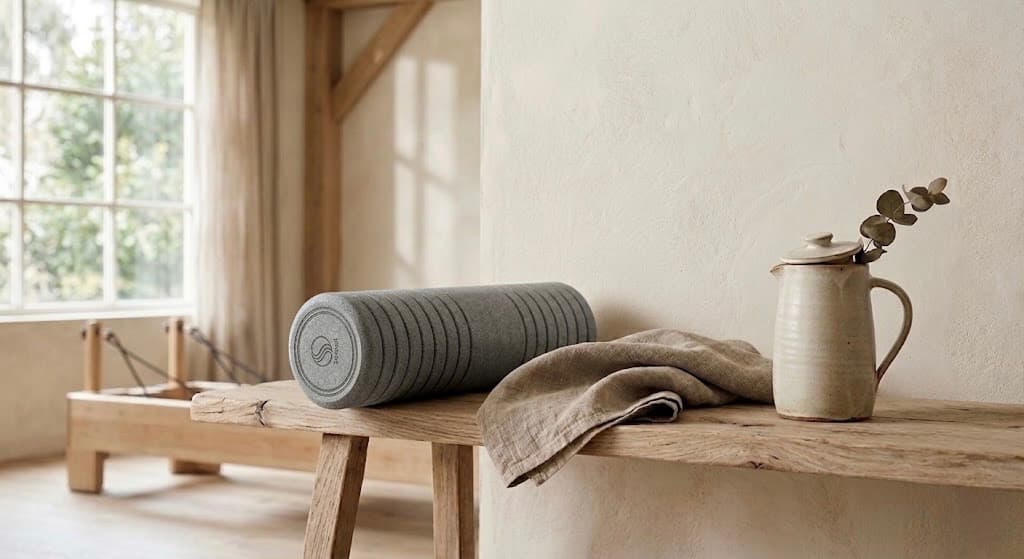
Foam keeps a record of every session it’s asked to survive — cork, so far, keeps none.
There is a standard test for this, and it is not gentle. ASTM D3574 Test D takes a foam sample, compresses it to half its original thickness, and holds it there — not for a minute, not for an hour, but for twenty-two hours at 70°C. Then it lets go. Thirty minutes later, someone measures what came back.
The gap between the original thickness and the recovered one is the compression set. Industry convention treats a result under 10% as excellent, 10–20% as acceptable, and anything past 20% as a foam likely to fail in service — to stop springing back at all.
Twenty-two hours: how long the foam test holds its sample under compression before anyone measures what didn’t return.
There is no equivalent number for cork. Not a gap in our sourcing — a gap in the literature. ASTM D3574 was written for urethane foam; no comparable long-hold compression-set standard has been published for cork, and we won’t invent a percentage to fill the space where one should be.
What the material science does show is a different mechanism entirely. Cork’s cell walls are corrugated, and under load they fold inward elastically rather than buckle or rupture — a structural response tied to a Poisson’s ratio that sits close to zero across most of the loading range, meaning the material compresses without pushing outward at the sides. Stress-strain studies also show cork holding a long, flat plateau from roughly 5% to 50% strain, with no sudden spike and no collapse. It is a cellular structure built to fold and unfold, not one built to be tested for how long it stays folded.
Foam takes a set. Cork returns.
The Two-Step Release: Hip Flexors
Calves, then thoracic spine. This week the line moves to the front of the hip — the region that shortens quietly every time you sit, and rarely announces itself until you stand up too fast.
The hip flexors cross from the lower spine to the top of the thigh. A chair holds them in their shortest position for most of a day; the release asks them to remember their longest.
Step 1 — Settle & Sink: Face down, forearms stacked under your shoulders. Roller just below the hip crease, across the front of one thigh. Let the weight settle for 30–60 seconds, breathing low into the belly.
Step 2 — Bend and Lengthen: Roller stays put. Bend the same-side knee, heel drifting toward the ceiling, then straighten. 4–6 slow reps, unhurried on both directions.
Elasticity is not the absence of tension. It’s tension that knows how to let go.
Total time: about two minutes. Repeat on the other side before you stand.
The Two-Minute Ceiling
Two minutes has been this letter’s practice unit since the first issue, chosen mostly for practicality — a length nobody has an excuse to skip. The research suggests it wasn’t a compromise. It’s close to the ceiling.
At 30 seconds the effect size is 1.01; at 90–120 seconds it peaks around 1.18–1.19; by 5 minutes it has declined to 0.29 (Behm et al., J Strength Cond Res 34(11), 2020 — acute range-of-motion outcomes with regular practice).
The last minute rarely does what the first one already did.
Takeaway: a 2022 meta-analysis of 290 participants found a moderate overall effect on range of motion from foam-rolling protocols, consistent with the same shape — benefit rising quickly, then leveling. Two minutes was never the minimum you could get away with. It’s close to the most there is to get.
The One-Minute Scan
The first two installments turned the dial inward — a full-body stretch, then a pulse you had to go looking for. This week the dial turns the other way, out toward the room.
Try this now: Without moving your body, let your eyes and neck travel a slow half-circle around the room — half the speed you think is slow. When something makes you want to stop scanning, stop there. Three breaths.
This is orienting — the nervous system’s habit of scanning the environment before it decides how much to guard. Most days it happens too fast to notice.
Slowed down on purpose, people often report the same thing: the room doesn’t change, but something in how they’re holding it does. Notice whatever that is for you. That’s the whole exercise.
Three Hundred and Sixty-One Years
In 1665, Robert Hooke sliced a piece of cork thin enough to hold to the light and put it under one of the first compound microscopes ever built. What he saw, he wrote, was a surface “all perforated and porous, much like a Honey-comb” — row on row of “little Boxes.”
He needed a word for the boxes. He borrowed one from architecture: cell — traditionally recounted as a nod to the small, spare rooms of a monastery, though the comparison as usually told doesn’t appear verbatim in his own text. The word stuck to biology entirely. It never let go of cork.
He was looking, without knowing it, at the same structure behind the number from the first issue — forty million sealed cells in every cubic centimetre. Hooke had no way to count them. He only had the shape under his lens, and the shape was enough to name the thing.
Three hundred and sixty-one years later, the word for the smallest unit of life is still, technically, a word about cork.
Cork is roughly eighty-five percent air by volume — the reason it floats, insulates, and returns instead of staying flat. Hooke saw the architecture in 1665. It took modern instruments another three centuries to put a percentage on it.
Written by

Sōmavel
Practitioners, movement specialists, and material researchers writing on the practice of recovery, and the materials and rituals that make it last.